
by TherapyWorks PT Department | Jul 2, 2013 | Physical Therapy
Summertime Fun with PT
It’s summertime and one of the best times for kids to go outside and do some activities to build important gross motor skills, strengthen muscles, increase balance and coordination, motor planning and endurance. There are all kinds of things they can do outside like the regular activities of riding a bike, running, jumping rope, skipping, galloping, jumping on the trampoline, playing on the swing set and going to the park.
Summer is a great time, but if it gets too hot outside, just jump in the pool and cool off with a swim. Running through the sprinkler and tossing water balloons are other fun activities to stay cooled off. Swimming is a great way to strengthen those muscles and make them work without the kids even knowing it.
Here are some more great activities that your child (and you) can do to help increase strength, balance, coordination, motor planning, endurance and overall gross motor skills:
- Younger kids love bubbles! Blow some bubble and have them stomp the bubbles, making sure that they use both the left and the right foot to stomp. Then blow some bubbles high and have them reach for them where they are standing on their tip toes. Chasing bubbles is also a great activity.
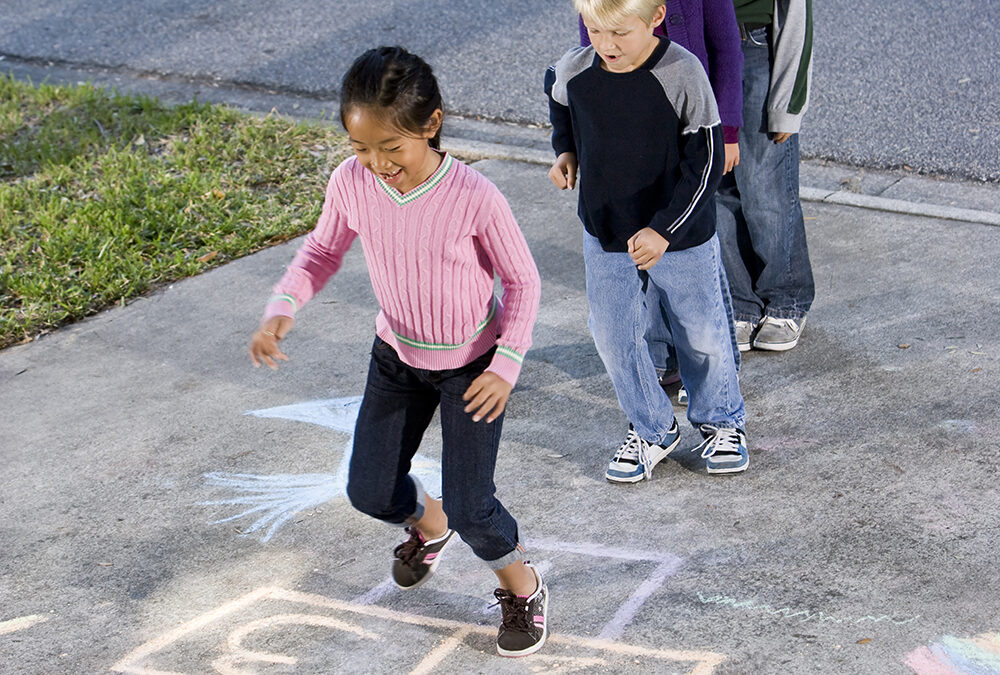
- Make hopscotch out of sidewalk chalk. Make sure when your child is hopping on one foot they alternate, one time with the left foot and then one time with the right foot.
- Walking on the curb with one foot in front of the other or draw a straight line with sidewalk chalk and walk the line with one foot in front of the other.
- Scavenger hunts are good for all ages. You can put the clues:
-
- Down low so the child has to squat and then stand back up
- Up high so the child has to reach on their tip toes
- Where they have an obstacle that they have to step over or climb over
- Where they have to climb up and down a couple steps
- Where they have to walk on uneven ground such as grass, gravel, sand, etc.
- Obstacle courses – make them fun with simple things you have around the house. Here are couple of ideas:
- Fill plastic bottles with water and put them in a zig zag pattern to run or hop through
- Jump over soft pool noodles or a garden hose
- Use a board or garden hose as a tightrope
- Crawl through boxes or army crawl across a blanket or sheet
- Toss balls or beanbags into a basket or bucket
- Kick a ball at a target (alternating feet when kicking)
- Set hula hoops down and jump from hula hoop to hula hoop
- Run, skip, gallop, run backwards, crab crawl, bear crawl
- Use Frisbees, horse shoes, bouncy balls, etc.
- Put a broomstick across a couple chairs to go under or do the limbo
There is so much to do outside, just make it fun and enjoy! Check out some summertime sensory ideas
here!
by TherapyWorks PT Department | Jun 10, 2013 | Physical Therapy
Commonly referred to as being “pigeon toed,” in-toeing is when a child walks with his or her feet turned inward. In-toeing can cause a child to seem more clumsy, demonstrate poor balance, and to trip and fall more frequently than peers. The cause of in-toeing can be the result of a few different factors.
- In-toeing can be due to the ankles and/or feet themselves being curved inward
- In-toeing can be the result of tibial torsion where the bones in the calves twist inward causing the feet to appear to turn inward when walking.
- In-toeing can be the result of femoral torsion where the long bones of the thigh twist inward causing the knees and feet to point inward.
- In-toeing can also be the result of shortened muscles in the ankles or hips.
 As mentioned in last month’s blog on W-sitting, when children sit in a W this can result in shortened muscles in the hips which can lead to in-toeing. Children who chronically sit in a W create excessive range of motion in their hips in one direction, while also creating a decreased range of motion in their hips in the opposite direction. This imbalance in the muscles surrounding the hips can make them very tight and can cause the entire leg to turn inward.
A physical therapist can help by assessing a child to determine which of these problems are causing the in-toeing. Depending on the cause of the problem a physical therapist will recommend the proper course of action, which may include:
- Stretching for tight muscles.
- Strengthening for weak muscles.
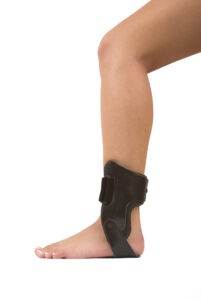
- De-rotation bands, which are elastic bands that help reposition in the legs in proper alignment.
- Eliminating W sitting in favor of sitting in criss-cross.

by TherapyWorks PT Department | Feb 12, 2013 | Physical Therapy
We’ve all seen it. Kids sitting on the floor with their knees bent, feet and toes pointed and legs out to each side, in a “W” position.
WHY do some children sit in this position?
Kids like to sit in a W because it’s easier. W-sitting creates a wide base of support, the child uses fewer muscles and it’s almost impossible to fall over when sitting in a W-position. Once a child learns to sit in a W-sitting position, it becomes a habit very quickly.
WHEN does W-sitting become a problem?
Consistent W-sitting can lead to orthopedic problems as your child gets older. Hip dislocation, twisting of the bones and shortened muscles in the hips and feet are some of the complications caused by W-sitting. In W-sitting, the child is unable to properly rotate his trunk which can cause delays in skills, such as crossing midline and transitioning from sitting to crawling to standing.
In addition, persistent W-sitters can become pigeon-toed because of the stress on the joints and shortened muscles that develop. (Look for more information on pigeon-toes in next month’s PT blog!). In worst case scenarios, surgery is required to fix the joints or to lengthen shortened muscles. It is easier to never let your child start W-sitting.
WHAT should I do if my child already is a W-sitter?
Try to work on other sitting positions such as criss-cross, longsitting (legs in front), and side sitting. You may have to remind him to move his legs to a different position. It will take a lot of repetition to correct the sitting position, but it will decrease the chances of complications in the future.
by TherapyWorks PT Department | Feb 5, 2013 | Physical Therapy
In response increasing number of torticollis cases, TherapyWorks recently formed the torticollis treatment team. Its primary goals are to create a uniform evaluation and treatment protocol and educate therapists on the latest treatment techniques. This ensures each patient receives the highest level of care and treatment benefits are maximized.
What is torticollis?
Torticollis is a condition in which the muscles on one side of an infant’s neck are tight or shortened resulting in the child turning their head to one side. A flat spot on the child’s head, also known as plagiocephaly, can result in a misshapen appearance.
Many infants are born with torticollis; however, some can acquire it in the first few months of life. Torticollis is a completely reversible condition if caught early. Research shows the sooner therapy begins, the faster changes and improvements are seen.
 Risk factors for developing torticollis include:- Lack of space in utero with twins or multiples
- In utero positioning
- Low amniotic fluid
- Positional deformity as a result of sleeping on back and/or in car seats or swings
- Traumatic birth
- Prematurity
Children with torticollis are affected in different ways such as:
- Head is tilted and turned to one side.
- Can’t turn head in opposite direction.
- Flat spot on back of head or one one side of head at 2-3 months of age.
- Some infants will have a misshapen head after birth but should resolve by 6 weeks of age.
- Uneven facial features or bulging of the forehead.
- Developmental milestones such as sitting, crawling and walking can be delayed.
The torticollis treatment team strives to minimize complications of torticollis through prevention, early intervention and treatment. Specialized treatment includes occupational and physical therapy provided by a team of extensively trained pediatric therapists.
Tummy Time and Positioning
- Place your baby on his or her tummy at least 30 minutes a day while awake and supervised. This can be for a few minutes at a time, multiple times a day.
- Alternate arms when holding or feeding.
- Reduce the amount of time in infant carriers, swings or car seats as much as possible.
See our blog on tummy time for more tips.

Treatment Techniques
Our physical therapists offer personalized treatment programs based on each child’s individual needs. Some of the treatment methods that may be used include:
- Stretching and positioning exercises
- Developmental skills facilitation
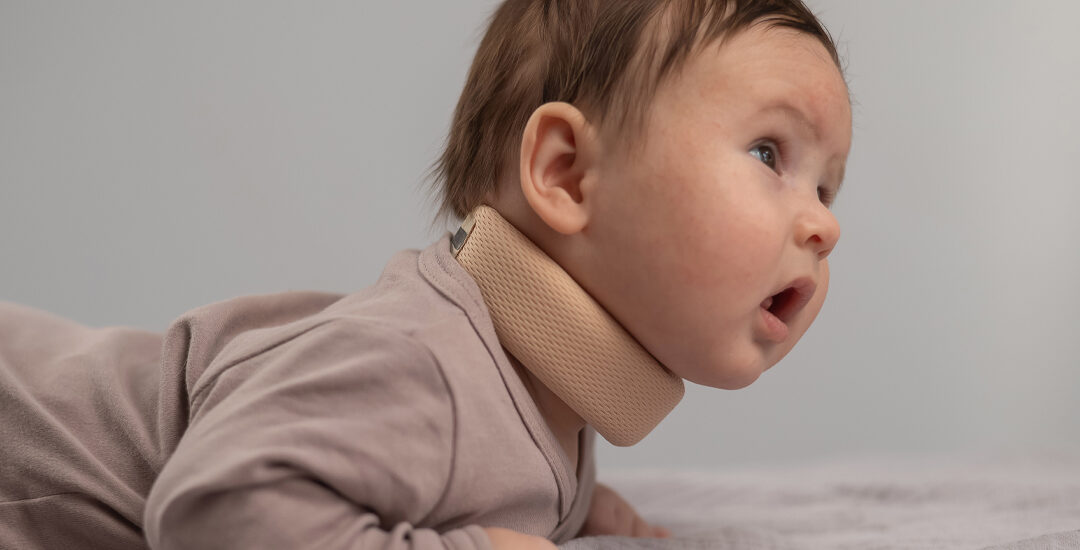
- Kinesio Taping®, TheraTogsTM or custom neck collars
- Electrical muscle stimulation/BOTOX®
- If treated early, helmet wearing or surgery can almost always be avoided.
Kinesio Taping® is a registered trademark of Kineso Taping Association International.
TheraTogsTM is a trademark of TheraTogs, Inc.
BOTOX® is a registered trademark of Allergan, Inc.


by TherapyWorks PT Department | Oct 25, 2012 | Physical Therapy
What is tummy time?
Tummy time is any activity or position that allows your baby to be on his or her stomach, including putting baby on the floor, your lap or chest.
How soon should I start tummy time?
Closely supervised tummy time can and should be started the day your child is born! The earlier you start tummy time, the easier tummy time will be as your infant grows older.
What are the benefits of tummy time?
Since the 1990’s, babies send a lot of time on their backs due to the American Academy of Pediatrics’ Back to Sleep program. Due to this, parents have become nervous about placing their infants on their tummies for play time. Studies show that infants with tummy time develop at a quicker pace than infants who are placed on their back. Tummy time promotes increases strength in the child’s neck and back muscles, as well as developing arm strength. Tummy time can help prevent tight neck muscles or flattening of the babies’ skull as a result of pressure on the back of their head. Tummy time will encourage development, such as rolling, sitting, and crawling.
What do I do if my infant hates tummy time?
Tummy time does not just have to be on the floor. Placing your child on your chest as you recline or lay down will also have benefits for your little one. Try placing music, light, or other toys where your infant can see them as they are on their tummy. If your child will not tolerate any of those positions, you can lay your child on their side and slowly progress to them lying on their stomach.
Do I need to supervise my child when they are on their tummy?
If you child is unable to lift his or her head from the floor, then yes! Do not leave your child unsupervised until your child is able to look up, is pushing up on his or her arms, and is able to roll out of the position.
How much tummy time do they need?
We encourage at least 60 minutes of tummy time a day. This can be 5 minutes at a time if needed, increasing time as they get stronger. Try tummy time after diaper changes – after you’ve diapered baby, turn baby over onto his or her tummy for a few minutes.