

What is “Crossing Midline”?
Imagine a line dividing your body into right and left sides. Crossing Midline includes any activity that requires one side to cross into the other side. Imagine using both hands to put on your shoes and socks, brushing your teeth, using your tongue to manipulate food from one side of your mouth to the other, combing your hair, reading, writing, etc.
Crossing midline all starts with crawling, which typically develops around age 7-11 months. Crawling is a very important developmental milestone. For many children, especially those with Autism, Dyspraxia (motor in-coordination), or Dyslexia, they may have “skipped” the crawling stage all together. Crawling is important because it works on upper and lower body dissociation, trunk/core rotation, weight bearing/weight shifting, reciprocal movement patterns, and dynamic movement transitions (ie.: quadruped to side sit, quadruped to ½ kneel, etc.). This is also a precursor for crossing midline which is necessary for the brain to communicate across the corpus collosum, the thick band of nerve fibers which connects the two brain hemispheres. This is required for higher level skills such as reading and writing. In fact, research has shown that children with dyslexia have smaller, less developed, corpus collosums.
- poor fine motor control (immature pencil grasp, poor manipulation skills)
- poor bilateral coordination (catching a ball, cutting skills)
- poor upper/lower body coordination (jumping jacks, riding a bike)
- poor right/left discrimination
- becoming “stuck” in mid-reach and having to switch hands
- Cross crawls (bring your opposite hand, or elbow, to your opposite knee) x20-30
- Behind-the-back cross crawls (touch your right hand to your left food behind your back so the child uses body awareness instead of vision!)
- Sit criss-cross and throw a ball to a target on the opposite side of the body (look for core rotation). Gradually increase the angle of the throw.
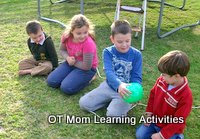
- Sit back-to-back (or for a group sit in a circle) and use trunk rotation to turn and pass an object (i.e.: ball). Remember to go 10-20x both directions!
- Simon Says or Hokey Pokey for right/left discrimination i.e.: “Touch your left ear with your right hand”
- Hand games (Patty-cake, etc.)
- Bongo drums (may have to use stickers to match opposite hand to opposite drum)
- Restrict one hand, and use opposite hand to reach/grasp a variety of items, remember to reverse so both preferred and non-preferred hands are used. (i.e.: Memory game cards, puzzle pieces, anything!)
- Place x10 pennies or playing cards as a semi-circle across the table. Make sure child is exactly in the middle of the table and does not lean over to compensate. Use one hand to flip each item over than the opposite hand to flip over again.
- “Infinity 8” – draw a horizontal 8 on the table, or better yet on a vertical surface such as a mirror or easel. Position the child exactly in the middle then trace the 8 with both hands together, then right, then left. Do 5-10 loops per hand. This can be especially fun with shaving cream and toy cars to make a “racetrack” on your table or window J
- Wand play: Make a “Racetrack” (figure 8), “Ferris Wheel” circles (in front), and “Helicopter” blades (overhead) with bubble wands, streamers, scarves, ribbons, etc.