
by TherapyWorks OT Department | Jun 3, 2013 | Occupational Therapy
It’s summer time and time to play, but why not continue the learning as well with some OT fun. As kids play in the summer and focus on all the fun activities, there are ways to incorporate and maintain the skills they have learned throughout the year while learning through play. Here are some ideas to do this summer to incorporate some fun OT skills!
Fine Motor Skills and Handwriting
 Keep a summer journal- have them write out one entry per day of what they did during that day. If working on reading skills, have them read aloud at the end of the week to remember all the fun things they did throughout the week! If they are not writing sentences yet, have your child draw a picture of their favorite thing that happened that day. This works on pre-writing shapes and drawing that is necessary for letter formation and will help improve visual motor skills as well.
- Make cereal necklaces on stretchy string so that they can wear throughout the day for a little snack. Lacing cereal such as cheerios or fruit loops works on grasping small objects as well using both hands to lace onto the string.
- Coloring and painting pictures with water colors is always a great way to improve grasp on different writing utensils. Also, using a vertical surface such as taping paper on a window or refrigerator, will promote improved grasp and proper hand positioning for handwriting. This is also great to pack for those summer vacations!
Visual-Motor/Perception Skills
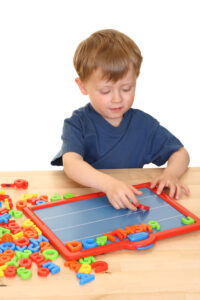
- Matching letter pieces then to written form with magnetic letters on the refrigerator. If you need to take a road trip then bring along a cookie sheet that can be used as a table. This helps practice letter identification, sequencing, name, and spelling.
- Complete various puzzles (interlocking or insert). You can make it more challenging by hiding it in a rice or bean bin and have them locate pieces. You can also hide them in various parts of the house and make it into a scavenger hunt by having them follow verbal or written directions. This works on listening and sequencing skills.
- Make a maze with sidewalk chalk on the driveway. Then have them follow with their bike or scooter, making sure they stay within the path. They will be working on problem-solving to find the end.
Sensory Play
- Swimming and various pool activities are a great way to get multi-sensory input with kids. Games such as basketball, searching for dive sticks underwater, playing “red light, green light” working on motor coordination and modulation allowing them to control their bodies when stopping or going.
- Messy Twister- it’s the regular Twister game board with a twist!! Place matching paint on the colored spots and play as directions instruct, except a lot messier!! This is suggested to play outside…unless you want multi-colored carpet!! Great for motor planning, right/left discrimination, and tactile sensory input.
- Make your own slime by taking 1 cup clear liquid glue + 1 cup of liquid starch. Separate into small bowls and add food coloring. Then squish, stretch, and play with slime! Very good tactile sensory play.

by TherapyWorks OT Department | May 1, 2013 | Occupational Therapy
Visual tracking and perception are important for many daily activities such as reading, gross motor skills such as playing catch, writing, board games and more. Poor visual skills also impact attention. If a child is unable to process visual input correctly they may become frustrated and shut down when trying to complete task or will be unable to attend to task. Poor visual processing skills are often times linked to ADD/ADHD symptoms. Many times parents will report that visual acuity is good, which is what there optometrist told them. What many parents don’t understand is that visual acuity and perception are two different things. Visual acuity is the ability to see clearly and sharply visual perception is how we process and interpret what we see for a functional outcome (“Visual Perception”, 2013).
Many families come to occupational therapy for concerns with poor reading skills, dyslexia concerns, poor attention, behaviors and poor coordination. Vision is a basic sense that we all rely on daily to complete just about any task we do. We need to be able to visually track, accurately localize and focus on an object, and use binocular vision to be able to read, write and move around and participate within our environment. As an occupational therapist we are trained in the basics of vision and can work with a child on these skills, although it is also recommended to consult with a vision therapist.
Megan is a 9 year-old girl that I have been working with for 7 months. When I first started working with Megan she had very poor reading skills as well as poor gross motor coordination, handwriting and poor attention to task. Megan has been working on various visual exercises, such as left/right discrimination, visual memory skills, tracking, and her ability to better quickly locate and focus in on an object. As she has been practicing to improve these skills in the clinic and at home with her parents she has shown very nice improvements in her ability to read, write and her gross motor skills such as catching a ball. Megan has improved her reading skills since starting OT from Kindergarten level to 2nd grade level! When playing games with her peers now she can better attend to the game, increased ability to read her own cards, and improved her ability move and sequence piece when playing board games. Megan’s demonstrated better visual spatial awareness, which has helped increase her gross motor skills. Her visual processing skills have played an important roll in improving her overall skills to help her better participate in many activities and improve her self confidence.
Visual perception. (2013, April 10). In Wikipedia, The Free Encyclopedia.
Retrieved 17:53, April 15, 2013, from http://en.wikipedia.org/w/index.php?title=Visual_perception&oldid=549759866

by TherapyWorks OT Department | Apr 29, 2013 | Occupational Therapy
At TherapyWorks, we “work wonders in children’s lives” with physical therapy, speech therapy and occupational therapy, along with diet and nutrition therapy. And while most people know about physical therapy and speech therapy and nutrition, a lot of people aren’t quite sure what occupational therapy is.
So, just what is Occupational Therapy???
Occupation can be defined as the way we occupy our time. It includes the daily activities of:
Self-Care: sleeping, eating, grooming, dressing, and toileting
Work: effort that is exerted to do or make something, or perform a task
Leisure: free, unoccupied time where you choose to do something enjoyable (i.e., hobby, tv, sports, socializing, read, listen to music, travel, etc.)
Occupation is how we spend our time; whether paid or unpaid, restful or fun, obligation or choice. It is that which fulfills us, gives us purpose, and allows us to interact with, be productive, and function in the world around us to the best of our ability.
If, at any point in our lives from birth to old age, an injury or disability prevents us from effectively or independently functioning in one or more “occupational” areas, then it is the job of the Occupational Therapist to provide treatment. OT helps you learn or regain function, maintain skills, or make accommodations for deficits you may experience. In other words, so that you may live life to the fullest! Since many people have never heard of OT, they think it is a relatively new profession. Actually it began in the late 1700’s but was not formally named occupational therapy until 1917. In the 1700’s the mentally ill were locked away in insane asylums and treated like prisoners. Phillipe Pinel, a French physician, and William Tuke, an English Quaker, started to challenge this treatment and developed new beliefs about how to improve the lives of the mentally ill. Phillipe Pinel began what he called “Moral Treatment and Occupation”, defining occupation as “man’s goal-directed use of time, energy, interests and attention”. He advocated for treatment based on purposeful daily activities. He used literature, music, physical exercise, and work as a way to “heal” emotional stress and improve the patient’s ability to perform activities of daily living (ADL’s).Tuke’s basic premise, called “moral treatment” was based on the principles of “consideration and kindness”. Tuke felt occupations, religion and purposeful activities should be used to improve function and minimize the symptoms of mental illness. He encouraged patients to participate in a variety of employment or “amusements” (leisure activities) that they enjoyed.
These ideas spread to the US and from 1840-60 many American hospitals began to use these new treatments. Arts and crafts activities were used for both relaxation and feelings of being productive. Many of these concepts were nearly lost during the upheaval of the Civil War. In the late 1890’s, nurse Susan Tracy successfully brought back the use of “occupation” with the mentally ill. She began to specialize in this field and started educating student nurses on the therapeutic use of activities as part of treatment. Tracy coined the term “Occupational Nurse” and called the training “occupation work”.
On March 15, 1917 Susan Tracy, Eleanor Clark Slagle of Johns Hopkins Psychiatric Clinic and 5 others formed the National Society for the Promotion of Occupational Therapy (NSPOT), which was later changed to the American Occupational Therapy Association (AOTA). The founders were dedicated to building a role for occupational therapy in the health care community that incorporated treating mind, body and spirit.
 During and after World War I over 5,000 reconstruction aides were hired to provide occupational therapy to the war’s wounded. In the 1920-30’s training programs were established at universities and OT expanded to include health care and hospital based medical treatment. Thousands of returning soldiers with physical injuries and mental problems from WWII, Korea and Vietnam received occupational therapy as part of the “Rehabilitation Movement”. During the 1950-60”s the practice of OT expanded and therapists specialized, providing treatment for the mentally ill in institutions, physically disabled adults and children with cerebral palsy and developmental disabilities. Medicare covered OT services starting in 1965 and in 1975 The Education of the Handicapped Act was passed and Occupational Therapy was included in the public schools as a “Related Service”.
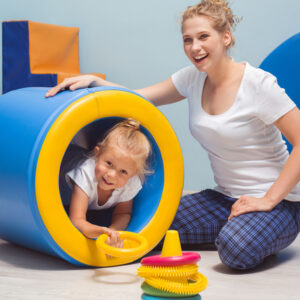
Today Occupational Therapists continue to use purposeful activities. Children occupy their time in play, learning and have a wide choice of “leisure” activities. By creating fun challenges and involving children in functional activities, arts and crafts, OTs help children gain strength, learn to problem solve, become more independent in their own care (dressing, bathing, chores), gain confidence and skills for social interactions, become more independent and ready to learn new skills and handle the challenges of the world they live in.
Suzette Werner Jones, OTR/L
President ,TherapyWorks, Inc.
Information from AOTA, Eleanor Clark Slagle lectures, Sensory Processing Disorder Website

by TherapyWorks OT Department | Apr 8, 2013 | Occupational Therapy
Nathan is a smart, spunky kindergartener who loves learning about animals and the environment. Nathan was getting into trouble at school for not keeping his hands to himself, interrupting the teacher and having difficulty remaining on task and staying seated. He began receiving occupational therapy about a year ago at TherapyWorks. While he had made some progress, his therapist recently implemented the How Does Your Engine Run?© Alert Program© to help improve self-regulation in order to decrease hyperactivity.
The Alert Program© was developed by occupational therapists Mary Sue Williams and Sherry Shellenberger in 1991, in order to create a shared language for students, parents, teachers, therapists and other professionals to use when improving self regulation and attention. According to their website, www.alertprogram.com, their mission is, “developing practical ways to teach people of all ages how to incorporate sensory integration theory into everyday living… and how understanding self-regulation can enrich the lives of children.”
The Alert Program© uses the analogy that your body is like a car engine; it can run too fast, too slow, or just right. For example, your engine is automatically running too fast if you are angry or are overly excited during recess.
Now that Nathan can accurately identify the engine level in himself and others, he has begun to learn different tools to use in order to change his engine speed. It is often a challenge to choose an appropriate activity to slow his engine and not simply pick a favorite activity!
Nathan is currently experimenting with changing his engine speed. He has learned body movement tools such as swinging, jumping, crashing, and climbing, used within a sensory diet for home and school, in order to calm and organize his engine to
the “just right” level. Next, he learned mouth tools such as resistive sucking through a straw (i.e. pudding or applesauce). Finally, hand tools, such as using a fidget toy or fabric fastener under the desk, keep his hands busy and his mind focused while learning.
His mother, Kimberly, has been very pleased with his progress in OT and using the Alert Program©. She explains, “In the past year, since beginning at TherapyWorks, Nathan has improved in so many areas, including self-regulation, social skills, attention and listening, behavior, coping skills, and so much more. He is now attending full days at school, whereas last year he was limited to half days. Nathan has always been an amazing, bright little boy, but he seems much happier and more confident now than when we first started at TherapyWorks. As a family we are so much better able to be successful and enjoy
each other. We are truly grateful to all of the amazing staff at TherapyWorks.”
How Does Your Engine Run?® and Alert Program® are registered trademarks of TherapyWorks, Inc.
TherapyWorks, Inc. 7200 Montgomery NE, Ste B9 Box 397, Albuquerque, NM 87109
Phone: (877) 897-3478; Fax: (505) 899-4071 Email: manager@AlertProgram.com Website: www.AlertProgram.com

by Phillip Kindschi | Feb 21, 2013 | Occupational Therapy, Physical Therapy, Speech Therapy
It’s often said it takes a village to raise children. With children with special needs, that village sometimes includes a number of therapists and specialists.
When children are brought into our clinic for their first assessment, the therapist may request additional assessments from other health care professionals. This allows therapists and parents to get a clearer picture of the child’s strengths and weaknesses and gives valuable information about how to best address the child’s individual needs.
Parents may feel overwhelmed or confused about these many specialists and may ask, “What does that person really do? Why is my child meeting with them?” Below is a basic review of some of the specialists your child may see and their unique role in your child’s treatment team.
At TherapyWorks, your child’s therapy team may include:
Speech-language pathologists give children the skills necessary for successful communication and meaningful interactions with others. Additionally, speech therapists assist children with feeding difficulties to eat and swallow safely.
Physical therapists work to improve muscle strength, range of motion, reflexes and coordination. Our physical
therapists are also trained to fit and cast custom foot orthotic devices. Orthotic supports align the foot or lower leg and improve posture, sitting, standing, walking and running.
Occupational therapists help children develop or regain skills necessary for play and work, and self and home care. Children may also need occupational therapy to help them with school and social skills. Play is important for a child’s mental, physical and emotional development. Occupational therapists also address sensory processing and integration problems which have a tremendous impact on motor skills, behavior, learning and a child’s ability to process information and respond to the demands and changes of daily living.
We also work with the following outside professionals to create a total treatment plan for your child:
Physicians emphasize the physical health of the child including height, weight gain, and absence of disease. Doctors also work closely with dieticians or nutritionists to ensure your child’s nutritional needs are being met for optimal growth and
development.
Psychologists and mental health professionals help people learn to cope with the daily stresses of life. For many of our families, psychologists provide strategies to help manage behavior issues to make children more successful at home and school. They also perform standardized assessment of developmental milestones.
Teachers and administrators address the educational/academic needs of children and work to meet educational mandates as required by state and federal laws.
Communication Intervention Birth to Three- 2nd Edition by Louis M Rossetti.
Delmar Publishing 2001 was referenced.

by TherapyWorks OT Department | Jan 10, 2013 | Occupational Therapy
Primitive reflex integration work is a newer technique beginning to be embraced by many different health professions. We are all born with reflexes to help us survive and learn as infants. Primitive reflexes are repetitive, automatic movements that occur in response to a stimulus, such as an infant sucking a nipple or bottle in order to eat.
Reflexes help to develop movement patterns, from involuntary (reflex pattern) to voluntary movement, and cognitive development. They are also the foundation for sensory integration as well as fine and gross motor coordination. If reflexes are not properly integrated, it could cause difficulties in daily life related to balance, coordination, gravitational insecurity, anxiety, reading and more.
Primitive reflex integration work is often called the “missing link.” It has been thought many children who have received therapy for years with minimal or no progress in a certain area, or are unable to maintain that progress, may have a reflex that has not been fully integrated. This interrupts the child’s ability to complete tasks efficiently or create a good foundation on which to build other skills. Once the reflex is integrated, gains in this area can then be seen.
In one particular case, a child, struggling with sensory integration, was highly anxious about most sensory input, refused to play on swings, was aversive to touch, had poor attention to task and was easily frustrated. The therapist began to work on some basic reflex integration exercises for gravitational insecurity and grounding the body. A little more than a month after starting the exercises, this child began to tolerate, and even initiates, playing on the swing. He is better able to self regulate and can attend to play tasks without running away for 10-15 minutes. The child also tolerates touch from the therapist with minimal resistance now. Overall, this child has shown remarkable progress in the clinic, at home and school and has led to great improvements in daily living.